




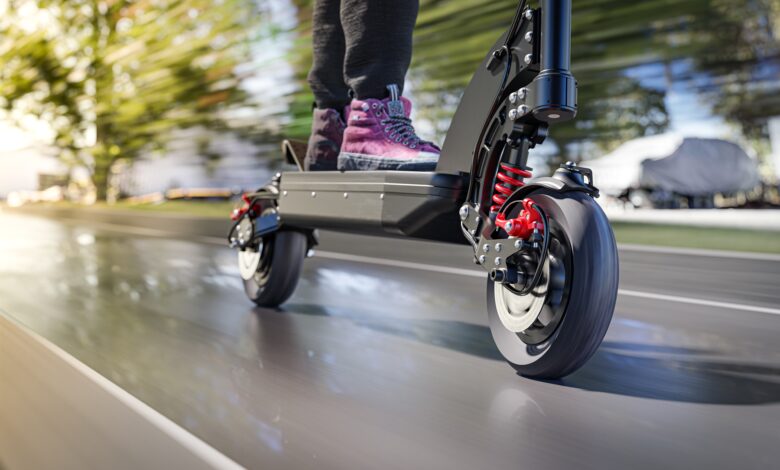
A new ordinance looking to curb the growing problem of unsafe operation of electric scooters and electric bikes in New Hampton went into effect Thursday (08.20).
The increasing popularity of E-scooters and E-bikes has also increased the opportunity for accidents for riders, but also motorists and pedestrians.
This week (08.17), the New Hampton City Council approved the third reading of the Personal Transportation Device (PTD) ordinance to regulate, among several items, where E-bikes and E-scooters can be ridden, helmet requirements, and limiting how many people can ride at one time.
Police Chief Conrad Rosendahl says the goal is making the streets safer for riders and those of the paths they may cross.
Rosendahl adds that the City now has a tool to take official action to deal with infractions.
The ordinance also includes penalties for repeat offenders, from impounding their PTD to possible fines.
***See ordinance below:
CHAPTER 77
PERSONAL TRANSPORTATION DEVICES
REGULATIONS
77.01 Definitions 77.08 Carrying Articles
77.02 Scope of Regulations & ADA Exemptions 77.09 Riding on Sidewalks
77.03 Age Restrictions and Authorized Riding Areas 77.10 Towing
77.04 Traffic code applies 77.11 Improper Riding
77.05 Double Riding Restricted 77.12 Parking
77.06 Two Abreast Limit 77.13 Equipment Requirements
77.07 Emerging from Alley or Driveway 77.14 Special Penalties
77.01 DEFINITIONS. All items identified within this chapter shall be defined as a “Personal Transportation Device” hereinafter.
1. Electric Bike (e-bike):
“Low-speed electric bicycle” means a device having a saddle or seat for the use of a rider, two or three wheels equipped with fully operable pedals, and an electric motor of less than seven hundred fifty (750) watts that meets the requirements of one of the following classes: “Class 1 low-speed electric bicycle” means a low-speed electric bicycle equipped with a motor that may be used to provide assistance only when the rider is pedaling and that ceases to provide assistance when the bicycle reaches a speed of twenty (20) miles per hour or more.
“Class 2 low-speed electric bicycle” means a low-speed electric bicycle equipped with a motor that may be used exclusively to propel the bicycle and that is not capable of providing assistance when the bicycle reaches a speed of twenty (20) miles per hour or more.
“Class 3 low-speed electric bicycle” means a low-speed electric bicycle equipped with a motor that may be used to provide assistance only when the rider is pedaling and that ceases to provide assistance when the bicycle reaches a speed of twenty-eight (28) miles per hour or more. The operator shall be 16 years of age or older.
2. Electric Scooter (e-scooter):“motorized scooter” means any two-wheeled device that has handlebars, has either a floorboard that is designed to be stood upon when riding or a seat and footrests in place of the floorboard, and is powered by an electric motor, weighing one hundred (100) pounds or less and a maximum speed of twenty (20) miles per hour.
3. Electric scooter means a device weighing less than one hundred (100) pounds that is equipped with one, two or three wheels, with or without handlebars, with or without a seat or saddle, and an electric motor, and which is solely powered by the rider or by an electric motor capable of propelling the device without additional propulsion supplied by the rider, at a maximum speed on a paved level surface of no more than twenty (20) miles per hour, or both.
4. Other Power-Driven Mobility Device (OPDMD) means any mobility device powered by batteries, fuel, or other engines that is used by individuals with mobility disabilities for the purpose of locomotion, including, electronic personal assistance mobility devices, or any mobility device designed to operate in areas without defined pedestrian routes, but that is not a wheelchair or a golf cart. Powered wheelchairs and other mobility devices used by individuals with mobility impairments are not covered by this Ordinance and are exempt as long as all signs and regulations are followed.
77.02 SCOPE OF REGULATIONS AND ADA EXEMPTIONS. These regulations shall apply whenever a Personal Transportation Device is operated upon any street or upon any public path set aside for the exclusive use of Personal Transportation Devices. Nothing in this Chapter shall be interpreted, applied, or enforced in a manner that limits, restricts, or denies the rights of any individual with a disability under the Americans with Disabilities Act (ADA), as amended, or other applicable federal or state disability laws. Individuals with disabilities may use wheelchairs, power wheelchairs, Other Power- Driven Mobility Devices (OPDMDs), and other mobility devices as permitted by law for the purpose of locomotion. Any age restrictions, licensing requirements, operational restrictions, dismount requirements, location prohibitions, impoundment provisions, or other regulations contained in this Chapter shall not apply where such application would
conflict with rights or reasonable accommodations required under the ADA. The City may impose only those restrictions on mobility devices that are authorized by law and based upon legitimate safety requirements. This ordinance is to Promote the safety and well-being of all operators using Personal Transportation Device within New Hampton City Limits.
77.03 AGE RESTRICTIONS AND AUTHORIZED RIDING AREAS.
1. No individual under the age of 10 may operate a Personal Transportation Device within the City of New Hampton unless under direct supervision of a parent or guardian.
2. Operators under the age of 16, without a moped or drivers permit, shall ride Personal Transportation Devices only on sidewalks, bike lanes, or designated multi-use paths where local law permits.
3. Operators 16 and older may operate a Personal Transportation Device on a city street as long as all state laws and regulations within this Chapter are followed.
4. It is required that operators under the age of 14 wear a rated for use of Personal Transportation Device helmet. A helmet should sit on top of the head in a level position, and should not rock forward, backward, or side to side. The strap must always be buckled, but not too tightly.
5. Operation on city streets with posted speeds over twenty (25) mph and/or any State or US Highways are strictly prohibited for operators of Personal Transportation Devices. This Includes Main Street in its entirety from the east corporate limits to the west corporate limits.
6. Operating Personal Transportation Devices in the Business District is prohibited, as described in chapter 60.02(1) of this code of ordinance. They must be dismounted and walked.
(Business District referenced here as: streets or sidewalks in the Business District from the North side of Spring Street to the south side of Prospect Street from Water Avenue to Linn Avenue, and all of Main Street.)
7. No one shall ride them on any City street after sunset and before sunrisewithout proper lighting and reflectors, identified in chapter 77.13(1).
8. The Tribe Trail may be used with a speed not to exceed fifteen (15) mph for Personal Transportation Devices. All Personal Transportation Device sidewalk and road use regulations apply on the trail.
77.04 TRAFFIC CODE APPLIES. Every person operating a Personal Transportation Device upon a roadway shall be granted all of the rights and shall be subject to all the duties applicable to the driver of a vehicle by the laws of the State declaring rules of the road applicable to vehicles or by the Traffic Code of the City applicable to the driver of a vehicle, except as to those provisions that by their nature can have no application. Whenever such person dismounts from a Personal Transportation Device, the person shall be subject to all regulations applicable to pedestrians.
1. Pedestrians & Passing: Personal Transportation Device operators must always yield to pedestrians and give an audible signal before passing.
77.05 DOUBLE RIDING RESTRICTRED. A person propelling a Personal Transportation Device shall not ride other than astride a permanent and regular seat attached thereto. None shall be used to carry more persons at one time than the number for which it is designed and equipped.
77.06 TWO ABREAST LIMIT. Persons operating Personal Transportation Devices upon a roadway shall not ride more than two abreast except on paths or parts of roadways set aside for the exclusive use of bicycles. Bike lanes shall be utilized when available.
77.07 EMERGING FROM ALLEY OR DRIVEWAY. The operator of a Personal Transportation Device emerging from an alley, driveway, or building shall, upon approaching a sidewalk or the sidewalk area extending across any alleyway, yield the right-of-way to all pedestrians approaching on said sidewalk or sidewalk area, and upon entering the roadway shall yield the right-of-way to all vehicles approaching on said roadway.
77.08 CARRYING ARTICLES. No person operating a Personal Transportation Device shall carry any package, bundle, or article that prevents the rider from keeping at least one hand upon the handlebars.
77.09 RIDING ON SIDEWALKS. The following provisions apply to riding Personal Transportation Devices on sidewalks:
1. Business District. No person shall operate a Personal Transportation Device upon a sidewalk within the Business District, as defined in Section 60.02(1) of this Code of Ordinances. Exception, OPDMD may be utilized on sidewalks within the Business District, if the individual has mobility impairments.
2. Other Locations. When signs are erected on any sidewalk or roadway prohibiting the riding of Personal Transportation Devices thereon by any person, no person shall disobey the signs. Exception, OPDMD’s may be utilized on other sidewalks, if the individual has mobility impairments as long as all regulations areobeyed by.
3. Yield Right-of-Way. Whenever any person is operating a Personal Transportation Device upon a sidewalk, such person shall yield the right-of-way to any pedestrian and shall give audible signal before overtaking and passing.
4. Maintain a safe distance. Operators shall maintain a safe distance when passing and slow to a walking pace when sidewalks are crowded.
5. Speed limit on sidewalks. No person shall operate a Personal Transportation Device at a speed greater than ten (10) mph on any sidewalk. A rider shall decelerate to a safe speed below ten (10) mph when passing a pedestrian.
77.10 TOWING. It is unlawful for any person operating a Personal Transportation Device to be towed or to tow any other vehicle upon the streets of the City unless the vehicle is manufactured for such use.
77.11 IMPROPER RIDING. No person shall operate a Personal Transportation Device in an irregular or reckless manner such as zigzagging, stunting, speeding, or otherwise so as to disregard the safety of the operator or others.
77.12 PARKING. No person shall park a Personal Transportation Device upon a street other than upon the roadway against the curb or upon the sidewalk in a rack to support the bicycle or against a building or at the curb, in such a manner as to afford the least obstruction to pedestrian traffic.
77.13 EQUIPMENT REQUIREMENTS. Every person operating a Personal Transportation Device shall be responsible for providing and using equipment as
provided herein:
1. Lamps Required. Every Personal Transportation Device when in use after sunset and before sunrise shall be equipped with a lamp on the front emitting a white light visible from a distance of at least three hundred (300) feet to the front and with a lamp on the rear exhibiting a red light visible from a distance of three hundred (300) feet to the rear, except that a red reflector on the rear may be used in lieu of a rear light, given that it is visible from all distances from fifty (50)feet to three hundred (300) feet to the rear when directly in front of lawful upper beams of headlamps on a motor vehicle.
2. Brakes Required. Every Personal Transportation Device shall be equipped with a brake that will enable the operator to make the braked wheel skid on dry, level, clean pavement.
77.14 SPECIAL PENALTIES. Any person violating the provisions of this chapter will be subject to standard penalties including the following:
1. Parents or legal guardians are responsible for ensuring their minor’s compliance with this ordinance.
2. The Operator or their guardian may be fined in the amount set via resolution by the city council each year.
3. Code of Ordinances allow the person’s Personal Transportation Device to be impounded by the City for not less than five (5) days for the first offense, ten (10) days for a second offense, and thirty (30) days for a third offense, in lieu of citation.
Stay Connected with KCHA News
Add KCHA News as a preferred source on Google to see more local news, weather, and sports in your feed.
Follow us on Facebook for breaking news, severe weather alerts, sports, and more.

